Asbestos in Older Ottawa Bathrooms: What Demolition Can Uncover
Older Ottawa homes can hide asbestos in tile, flooring, and walls. A lab test before demolition keeps your renovation safe.
Quick AnswerShould you worry about asbestos in an older Ottawa bathroom? Asbestos in older bathrooms is common. If your home was built before the early 1990s, several common materials can contain asbestos, including old floor tiles and their adhesive, the mortar bed under wall tile, drywall joint compound, plaster, textured ceilings, and pipe wrap. These materials are safe when left alone and only release fibres when they are cut, drilled, sanded, or torn out during demolition.
You cannot tell whether a material contains asbestos by looking at it, so the only reliable answer is a lab test before any demolition starts. If asbestos is confirmed, a licensed abatement contractor removes it, not a renovation crew. Bytown recommends testing first, works around licensed abatement, and then renovates your bathroom safely. Book a complete bathroom renovation assessment for a written, upfront plan.
A bathroom demolition looks straightforward until the first tile comes off the wall. In older homes, that first swing can disturb material that has sat quietly for decades. Asbestos was used in dozens of ordinary building products until the 1980s, and plenty of it is still behind the tile and under the floor of bathrooms across Ottawa, Kanata, Nepean, Barrhaven, and Orleans. Knowing where asbestos in older bathrooms hides, and testing before you start, is the difference between a safe renovation and an expensive, hazardous surprise.
Why Older Ottawa Homes Are at Higher Risk
Asbestos was a standard ingredient in construction materials for most of the twentieth century because it was cheap, fireproof, and durable. Its use was heavily restricted through the 1980s, but Canada did not ban it outright until 2018, so almost anything built or renovated before the early 1990s can contain it. A large share of Ottawa’s housing stock predates that cutoff, which means a great many of the city’s bathrooms were built during the decades when asbestos products were normal.
The age of the house is the first clue, but it is only a clue. A 1960s bungalow that was never updated is an obvious candidate, yet a home that was partly renovated in the 1980s can also hold asbestos in the layers that were added then. That is why age alone never replaces testing. It simply tells you how carefully to approach the demolition.
Where Asbestos Hides in Older Bathrooms
Bathrooms are one of the more likely rooms to hold asbestos because so many of their materials were once made with it. During demolition, the most common places we see flagged for testing are these:
Floor tiles and the black adhesive under them
Nine inch by nine inch vinyl or vinyl-asbestos floor tiles are a classic sign, and the dark, tar-like mastic that holds them down often contains asbestos even when the tile above it does not. Sheet vinyl flooring and its backing from the same era can also contain it.
The mortar bed and wall materials
The thick mortar or mud bed poured under old wall and floor tile can contain asbestos, and so can drywall joint compound, taping mud, and the plaster used in older walls and ceilings. Because joint compound was spread across every seam, disturbing a single wall can release fibres from a wide area.
Ceilings, pipe wrap, and insulation
Textured or popcorn ceilings, the paper-like wrap on old heating and water pipes, and vermiculite insulation that spills down from an attic or a bulkhead are all recognised asbestos sources. Window putty and some old caulking round out the list.
Asbestos in Older Bathrooms Is Only Dangerous When Disturbed
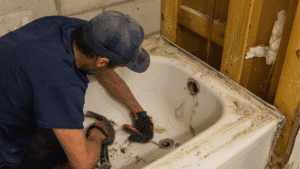
This is the most important point for any homeowner to understand. Asbestos that is intact and left alone is not releasing fibres into your air. The health risk comes from breathing in fibres, and those fibres are released when the material is broken up, which is exactly what demolition does. Cutting old tile, drilling into plaster, sanding joint compound, or ripping out a mortar bed can send microscopic fibres into the air where they linger and can be inhaled.
That is why the worst thing to do is treat an old bathroom like a quick do-it-yourself teardown. A homeowner with a pry bar and a shop vacuum can disturb far more asbestos in an afternoon than intact material would ever release on its own. If the material is going to be disturbed, it needs to be tested first and, if positive, handled by professionals under controlled conditions.
You Cannot Tell by Looking: Testing Comes First
There is no way to identify asbestos by sight. Two tiles that look identical can differ, and only a laboratory can confirm it by analysing a small sample. In Ontario, a material is treated as asbestos-containing when it holds 0.5 percent or more asbestos by dry weight. A qualified inspector takes samples safely and sends them to an accredited lab, and the written result tells you exactly what is present and where.
This is not just good practice, it is the law on a renovation. Ontario Regulation 278/05 requires that a building owner identify asbestos-containing materials before renovation or demolition work disturbs them, record the location and condition in writing, and share that information with any contractor doing the work. Testing before demolition is how you meet that duty and protect everyone on site.
How Asbestos Is Handled Safely in Ontario
If a test comes back positive, removal is regulated work, not a job for a general renovation crew. Ontario sorts asbestos work into three types by how much risk it carries, and each has its own required controls.
| Type of work | What it covers | Who does it |
|---|---|---|
| Type 1 | Lowest risk tasks, such as handling small amounts of non-friable material | Trained workers with basic protection |
| Type 2 | Moderate risk, such as removing tile, flooring, or drywall compound with controlled methods | A licensed abatement contractor |
| Type 3 | Highest risk, such as large or friable removals, using full enclosure and negative air pressure | A licensed abatement contractor with clearance air testing |
Most of what a bathroom demolition disturbs, tile, flooring, mortar beds, and joint compound, falls into Type 2 or Type 3 work. A homeowner cannot legally do that work, and neither can a renovation company. It takes a certified abatement contractor who seals off the area, removes the material under containment, and confirms the air is clear before anyone else works in the space.
What This Means for Your Ottawa Bathroom Renovation
Knowing the risk changes how a smart renovation is sequenced. Here is the order that keeps asbestos in older bathrooms from becoming a problem and the project safe and on schedule:
- Test before you touch anything. Have suspect materials sampled and lab-tested before demolition is booked, so results are back before any tile or flooring is disturbed.
- Never dry-scrape or sand suspect material. If you are living with an old bathroom while you plan, leave intact tile, flooring, and ceilings alone rather than sanding or drilling them.
- Use a licensed abatement contractor for removal. If a test is positive, abatement is done by a certified contractor under containment, with clearance testing to confirm the air is safe.
- Keep the paperwork. Hold onto the test report and the abatement clearance, both for your own records and for the renovation crew that follows.
- Then renovate. Once the space is confirmed clear, the rebuild, new waterproofing, tile, fixtures, and finishes, proceeds like any other project.
How Bytown Works Around Asbestos in Ottawa
We are a bathroom renovation company, not an asbestos abatement contractor, and we are straight with homeowners about that line. On an older home we do not swing a hammer into suspect material and hope for the best. If a bathroom is old enough to raise the question, we recommend testing before demolition, and if asbestos is confirmed we wait for a licensed abatement contractor to remove it and clear the space.
Once the bathroom is confirmed safe, our professionally trained installers take over and build it properly, with a written and upfront quote from the start. We serve Ottawa homeowners, we renovate bathrooms only, and we would rather add a testing step than put your family or our crew at risk. For the full pricing picture on the rebuild that follows, our bathroom remodeling cost guide sets out every project size, and a bathroom remodel assessment is free.
This article is general information for homeowners and is not a substitute for professional asbestos testing or legal advice. Always rely on a qualified inspector and a licensed abatement contractor for your specific home.
Frequently Asked Questions
How do I know if my older bathroom has asbestos?
You cannot know by looking. If your home was built before the early 1990s, treat old tile, flooring, mortar beds, joint compound, plaster, textured ceilings, and pipe wrap as suspect and have them lab-tested before any demolition. Only a laboratory result confirms whether asbestos is present.
Is asbestos in a bathroom dangerous if I leave it alone?
Intact asbestos in older bathrooms that is left undisturbed is not releasing fibres and is generally low risk. The danger comes when the material is cut, drilled, sanded, or demolished, which sends fibres into the air. That is why testing before a renovation matters so much.
Can I remove asbestos tile or flooring myself?
No. Removing asbestos tile, flooring, or drywall compound is Type 2 or Type 3 work in Ontario, which a homeowner cannot legally do. It must be handled by a licensed abatement contractor who works under containment and confirms the air is clear afterward.
Does Bytown remove asbestos?
No. We are a bathroom renovation company, not an abatement contractor. We recommend testing before demolition on older homes, wait for a licensed abatement contractor to remove any confirmed asbestos, and then build your new bathroom once the space is clear.
Do I need a test if my home was renovated in the 1980s?
Yes, a 1980s renovation can still contain asbestos, because many products were used until the early 1990s. A partial update from that era can add asbestos-containing layers, so testing before demolition is still the safe choice.
Renovating an Older Bathroom in Ottawa? Book a Free In-Home Assessment
We help you plan the safe way, testing first, working around licensed abatement, then rebuilding your bathroom right, with a written, upfront quote.
Bytown Better Bathtubs and Showers | 3894 Russell Road, Ottawa, ON K1G 3N2
(613) 746-8055 | info@bytownbath.ca | Monday to Friday, 8am to 5pm
Related Guides from Bytown Bath
| Guide | What you will learn |
|---|---|
| Complete Bathroom Renovation Ottawa | Scope and inclusions when an older bathroom is rebuilt fully |
| Bathroom Remodeling Cost Ottawa | The full pricing range for every project size in the city |
| Bathtub Remodel | What a tub-focused remodel covers in an older home |
| Shower Installation Ottawa | How a fully waterproofed shower is built after demolition |
| Tub-to-Shower Conversion Ottawa | Replacing an old tub with a new waterproofed shower |
Helpful Outside Resources
| Resource | Why it helps |
|---|---|
| City of Ottawa: Do I Need a Building Permit | Which renovation and demolition work needs a permit in Ottawa |
| Ontario Regulation 278/05: Asbestos | The provincial rules for asbestos on renovation and demolition work |
| Health Canada: Health Risks of Asbestos | How asbestos affects health and how exposure happens |
| CCOHS: Asbestos | Canadian occupational health guidance on handling asbestos |
| CMHC | Guidance on home maintenance, renovation, and indoor air |